| Check out Part I or Part II of my Siggraph review. |
|
|
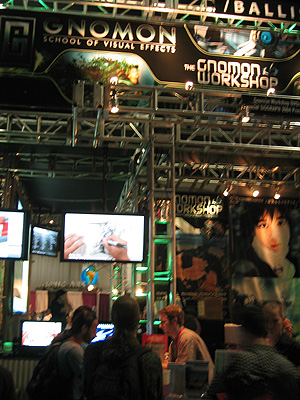
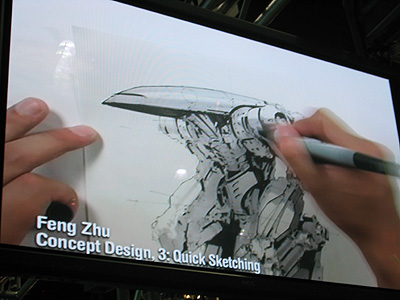
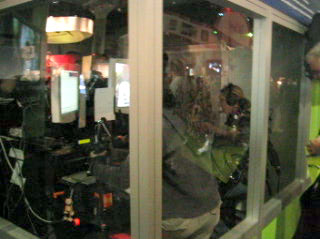
| I was excited at the chance to work with the artist drawing on this screen. This was at the Gnomon School of Visual Effects booth (blurry establishing shot). Feng used to be employed by my current company, which I saw as an extra perk of working there. He's a great visual artist, and I had looked forward to being on a team with him. I went to lunch with him and the rest of the team on my interview day, but then between that and my getting hired, something happened, and he left the company. Ah well. If I really feel the need to learn from him, I guess I can still get one of his instructional DVDs (1, 2, 3) |
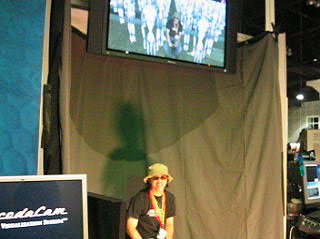 A volunteer being "chromatte" keyed (304kb MOV) |
| Next I stumbled upon a novel idea for green/blue screening an actor into a virtual environment. Rather than setting up a screen, or "cyc," which both require powerful and expensive lighting, Reflecmedia has created a material known as "Chromatte." Chromatte contains thousands of tiny glass beads embedded into it, similar to glass bead movie screens. It's designed to reflect light directly back to its source. The second part of the equation is the LiteRing. The Chromatte and LiteRing links will explain better, and make sure you check out the demo movie at the bottom of either. It's pretty cool, and there's some realtime Invisibility Cloak action, too! Sadly, the Chromatte material itself is required for this to work. I can make the LED ring myself, for far less than the nearly $500 going rate, but Chromatte works out to be about $40+/sq. ft. That's for a roughly 8'x8' square. As the size increases, the bulk price drops, but prepare to spend at least $2k, and as much as $6k, just for the cloth. |
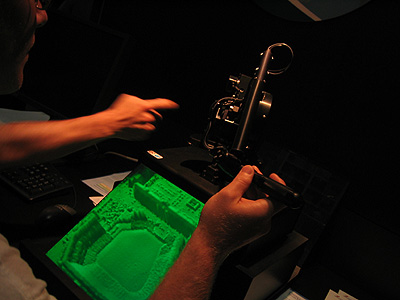 Haptic Hologram (195kb MOV) |
|
Here's a neat idea back in SensAble's haptics area. Unfortunately, it just didn't work as well as I hoped. The guys working this area were pretty upset, saying things like "Oh man, it's off again? The idea was to use a haptic response stylus and a hologram to allow you to see in 3D, and feel the resistance and surface of the hologram. Basically, it's supposed to feel like you're dragging the stylus all over a real 3D scene, all while the force-feedback motors inside never actually let you touch the surface of the image. Obviously, with a hologram, this works best from a single vantage point, and it seemed I was a bit tall for that, Also, people kept moving the hologram around, so it just kept getting more and more out-of-whack all day. They had a much better showing in other areas, including a nicely refined system, the Phantom Omni, with demos that allowed me to paint in a manner similar to a Wacom (slightly less easy, but cool anyway), and 3D stuff where I could feel the surface of things, or push a ball all over the surface of a clay head and even slowly push-dig right through it (the feedback made it feel VERY real). They have a developer contest I should point out, given that I have some friends in electronics and engineering majors. The kit costs about $2k, but if you're into haptics, and can get your school to sponsor it, or you're just rich and curious, go for it. The grand prize for best use of their haptic system is US $10K. Not too shabby. |
|
| The Henson digital puppeteering roadshow was there, teamed up with NVidia's Dawn. I last ran into these two awesome muppeteering ladies at this year's E3. Read all about them on the 4th page of my E3 2004 review. |

|
| Hoodman was in the house, keepin' it real. I thought at first he was "from the hood," or maybe as Duffman does with Duff, he was there to hand out Hood Beer. These were both wrong ideas. Hoodman is a line of glare guards and sun hoods for just about everything with a screen or eyepiece. |
|
|
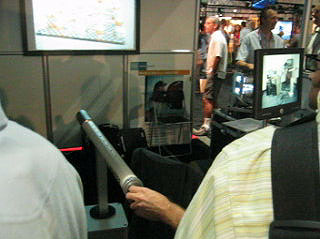
More haptics! FCS Robotics brought their HapticMASTER, a horizontal pole mounted on top of a vertical pole, sticking out of a box. You could rotate and slide the horizontal pole around the vertical, and the rods assembly could be raised/lowered from the box, providing a volumetric sweep of motion. Imagine a grid (on the flat panel display) of about 4x4 spheres spread out horizontally slightly above a plane. They're all connected horizontally in both directions to the 4 spheres surrounding them. The springs terminate at the outer ring of spheres, which are themselves anchored in space. Your haptic arm was connected visually to a floating sphere. When you hit one of the spheres in the middle with your control sphere, you sent a very natural-feeling physics system into motion, as all the spheres rippled as if connected by real springs. The feedback was uber real. You could feel in your hand, via the rod, the spherical nature of both your in-world avatar, and those on the springs, as well as the solid stopping force of the floor. If you struck a spring sphere, you'd feel the clack, and then as it rebounded through spring force, returning to you it would knock your hand back at the appropriate reflected angle, and you'd feel the repeated clacking as it slowed to a vibrating stop. You could hit the floor, then run along the bottom on the floor, and feel the spheres bouncing off the top of you, returning to pound you against the floor. The system had the feeling of billiard balls. I asked the guy there how they managed to get such a real feel. He said it was all done through motors and lead screws. Amazing! |
|
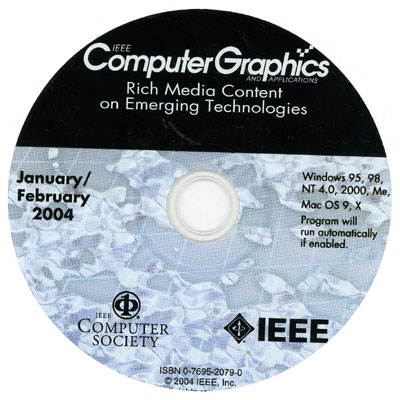
| I picked up a freebie disc from IEEE Computer Graphics and Applications. I didn't notice until tonight that it was more emerging technology stuff. Popping it in gave me a directory of many more wacko inventions that various, mostly foreign companies are working on. I love this kind of stuff. It borders on Chindogu, the Japanese art of useless/trivial inventions. Speaking of which, I just saw "Up All Night" with Dave Attell tonight - the first of his "Sloshed In Translation" episodes, and he went for a little visit with Kenji Kawakami, a leading Chindoguist and author of two books on the subject. Most of the things on the disc turned out to be stuff available from last year's emerging tech area of Siggraph. |
|
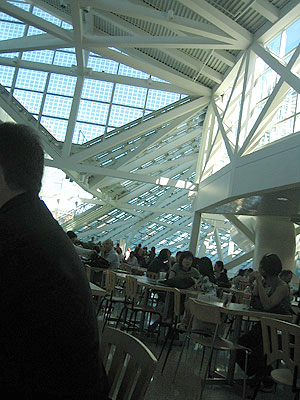
| A view from the cafeteria. I ran into an old coworker here, and found out he's going to be my replacement at the last place I worked. Small world. Very small world. I ran into so many people at the convention from previous jobs, my current job, school, and even some that are just friends or acquaintances from the LA area. I'd put the guesstimate at about 20 or 25 people over the course of the 3.5 hours I was there. Amazing. |
| That's it for part III. The next is my favorite, and will be somewhat larger than this one. In part IV I enter the Emerging Technologies wing of Siggraph, by my reckoning, the coolest part of the whole deal. |
| Check out Part I or Part II of my Siggraph review. |